The UK accounting industry is changing rapidly. Accounting firms are managing increasing client expectations, tight reporting deadlines, changing tax requirements, and growing workloads. At the same time, recruiting and retaining experienced accounting professionals can be expensive and time-consuming.
For many practices, accounting outsourcing offers a practical way to manage these challenges without continually expanding their in-house teams.
By outsourcing selected accounting and back-office tasks, UK accounting firms can improve workflow efficiency, manage busy periods, and dedicate more time to client relationships and business development.
Nippon Data provides accounting support and outsourcing services to help accounting firms manage routine accounting tasks, improve operational efficiency, and scale their services according to business needs.
In this guide, we explain how accounting outsourcing works, which services can be outsourced, and how UK accounting firms can choose the right outsourcing partner.
What Is Accounting Outsourcing for Accounting Firms?
Accounting outsourcing is the process of assigning selected accounting, bookkeeping, and administrative activities to an external service provider instead of completing every task in-house.
For UK accounting firms, this may include bookkeeping, bank reconciliations, accounts preparation support, VAT-related bookkeeping, management accounts preparation, and other agreed back-office activities.
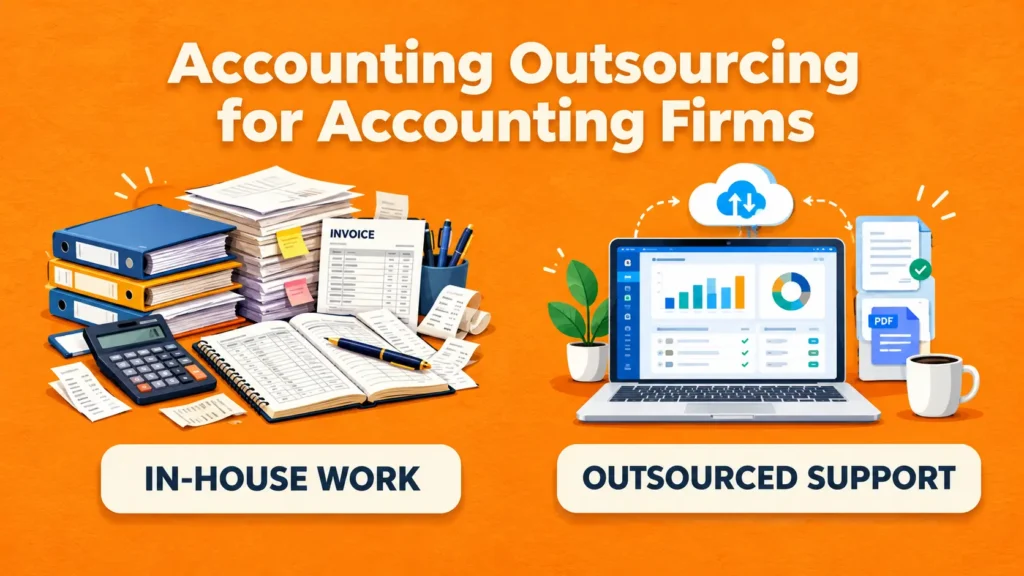
The outsourcing provider works according to the firm’s procedures, software requirements, review process, and deadlines. The UK firm can retain responsibility for client relationships, professional judgement, final reviews, and regulated work where applicable.
The main objective is to increase capacity without placing unnecessary pressure on internal resources.
For example, an accountancy practice with a growing client base can outsource routine bookkeeping tasks so its internal team can focus on client advice, tax planning, complex accounts, and higher-value services.
Accounting Practice Outsourcing UK: How It Helps Growing Firms
Accounting practice outsourcing in the UK helps accountancy firms manage increasing workloads while maintaining a flexible operating model. Instead of hiring additional employees for every increase in client demand, firms can outsource suitable tasks to an experienced external team.
This approach can be particularly useful during Self Assessment season, year-end accounts preparation, VAT deadlines, and other busy periods.
Key benefits include:
- Better workload management: Distribute routine accounting tasks across an additional support team.
- Flexible capacity: Adjust the level of support according to client numbers and deadlines.
- More time for clients: Allow in-house accountants to focus on advisory work and client communication.
- Improved workflow consistency: Use agreed procedures, review checklists, and reporting processes.
- Support for business growth: Take on additional clients without relying entirely on internal recruitment.
Outsourcing does not remove the need for quality control. A clear division of responsibilities, secure data-sharing arrangements, and regular reviews are essential for maintaining service quality.
Outsourcing for Accounting Firms: Services You Can Outsource
Outsourcing for accounting firms can cover a wide range of routine and process-driven accounting activities. The right combination depends on the firm’s client portfolio, software, internal expertise, and quality requirements.
Common services include:
- Bookkeeping and transaction processing
- Bank and balance sheet reconciliations
- Accounts payable and receivable support
- Preparation of working papers
- Management accounts preparation support
- VAT bookkeeping and return preparation support
- Payroll processing support, where agreed
- Year-end accounts preparation assistance
- Data entry and accounting record maintenance
For UK firms, the scope should be agreed clearly before work begins. Activities involving tax advice, statutory sign-off, regulated services, or professional judgement may require additional oversight or must remain with appropriately authorised professionals.
Outsourcing routine tasks can help accountants spend less time on repetitive work and more time delivering value to their clients.
Accounting Firm Back Office Outsourcing: Reduce Operational Pressure
Accounting firm back office outsourcing focuses on the internal processes that keep an accounting practice running smoothly. These activities are important, but they can consume significant staff time when managed entirely in-house.
A well-organised back-office arrangement may include transaction processing, document organisation, reconciliation support, working paper preparation, and routine reporting assistance.
Consider a UK accounting firm managing hundreds of client records. Its team may spend substantial time collecting documents, checking transactions, updating accounting systems, and preparing records for review. With a structured outsourcing workflow, suitable tasks can be assigned externally while the firm’s accountants retain control of review and approval.
To make the arrangement effective, firms should establish:
- Standard operating procedures for recurring tasks
- Clear deadlines and responsibility assignments
- Defined review and escalation processes
- Appropriate access permissions for accounting systems
- Secure methods for exchanging client information
- Regular performance and quality checks
The result can be a more organised back office and a clearer division of work between internal accountants and outsourced support staff.
Back Office Accounting Services UK: What Should You Look For?
When comparing back office accounting services in the UK market, accounting firms should look beyond the price. A suitable provider needs to understand the firm’s processes, communicate clearly, and work within its established controls.
Evaluate potential providers against the following criteria.
Accounting expertise: Check whether the provider has experience with the types of accounting work your practice handles.
Software compatibility: Confirm that the team can work with your existing accounting systems and agreed processes.
Data protection: Establish how client information is accessed, stored, transferred, and protected. Review relevant contractual obligations and UK GDPR requirements.
Quality assurance: Ask how work is checked, errors are escalated, and corrections are handled.
Communication: Agree on contact points, reporting frequency, working hours, and turnaround expectations.
Scalability: Ensure the service can accommodate changes in client volume and seasonal demand.
UK accounting firms should also assess their obligations under applicable professional standards, anti-money laundering requirements, confidentiality rules, and client engagement terms. Outsourcing work does not automatically transfer the firm’s regulatory responsibilities to the service provider.
Accounting Practice Support Services: Helping Firms Focus on Clients
Accounting practice support services help reduce the administrative and operational burden associated with managing client accounts.
These services can be particularly valuable for small and medium-sized UK practices where a limited team handles bookkeeping, accounts preparation, tax-related work, client communication, and practice administration.
Depending on the agreed scope, support may include preparing accounting records, organising documentation, maintaining reconciliations, producing working papers, and assisting with management reporting.
The key advantage is that accountants can spend more time on activities that require their experience and judgement.
For example, instead of completing every routine bookkeeping task themselves, an accountant may review prepared records, investigate unusual transactions, discuss financial performance with clients, and identify opportunities for additional advisory services.
When selecting a support provider, accounting firms should establish clear service boundaries, review arrangements, and escalation procedures. These measures help keep the outsourced workflow aligned with the firm’s expectations.
Offshore Accounting Services for UK Firms: Benefits and Considerations
Offshore accounting services for UK firms involve assigning selected accounting activities to a team based outside the United Kingdom. For firms choosing a suitable provider, this can offer an additional source of operational capacity and flexibility.
Offshore support may cover bookkeeping, reconciliations, working papers, accounts preparation assistance, and other agreed accounting processes.
Potential advantages include:
- Flexible resourcing: Access additional support when internal workloads increase.
- Cost management: Compare the total cost of outsourced delivery with the cost of performing the same work internally.
- Capacity for growth: Support additional clients without relying solely on local recruitment.
- More time for professional services: Allow UK-based staff to concentrate on client advice and review.
- Process consistency: Establish repeatable workflows for routine accounting activities.
However, offshore outsourcing requires careful planning. Firms should evaluate the provider’s technical competence, staff training, service continuity, communication processes, and ability to meet UK accounting requirements.
Data protection deserves particular attention. Where personal data is accessed from or transferred to a country outside the UK, the firm should assess the applicable UK data protection rules, international transfer requirements, contractual safeguards, and security measures. Appropriate confidentiality agreements, access controls, and documented procedures are also important.
An offshore provider should understand the firm’s requirements and work under a clearly defined service agreement. The UK accounting firm should retain appropriate oversight and verify the quality of completed work.
How to Choose the Right Accounting Outsourcing Partner in the UK
Choosing an outsourcing partner is an important decision because the provider may handle sensitive financial records and recurring accounting activities.
Before making a decision, UK accounting firms should assess the following factors.
- Understand your requirements. Identify which tasks create the most pressure on your team and decide which activities are suitable for outsourcing.
- Check relevant experience. Look for experience supporting accounting practices and working with UK client records and accounting workflows.
- Review data security measures. Ask about access controls, confidentiality, data storage, incident management, and international data transfers where applicable.
- Agree on responsibilities. Define who prepares, reviews, approves, and submits each piece of work.
- Start with a manageable workload. A pilot project can help assess accuracy, communication, turnaround times, and workflow compatibility.
- Measure performance. Monitor error rates, turnaround times, outstanding queries, and the amount of internal review required.
Why Choose Nippon Data for Accounting Outsourcing?
Nippon Data Consulting supports businesses with accounting and back-office services designed to help streamline routine financial processes and manage operational workloads.
For UK accounting firms, an outsourcing arrangement can be structured around agreed service requirements, existing accounting workflows, and the level of support needed. This can help practices manage recurring accounting tasks while allowing their in-house professionals to focus on client relationships, review, and advisory services.
When considering an outsourcing partnership, accounting firms should discuss their specific requirements, software environment, expected turnaround times, data protection needs, and quality assurance procedures with the service provider
Conclusion: Grow Your Accounting Practice with the Right Outsourcing Support
Accounting outsourcing can help UK accounting firms manage routine workloads, improve operational flexibility, and create more time for client-focused services. Whether a practice needs bookkeeping assistance, back-office support, or an outsourced accounting team, the right arrangement should align with its workflow, security requirements, and quality standards.
By establishing clear responsibilities and maintaining appropriate oversight, firms can use outsourcing as a practical part of their growth strategy.
Looking for accounting outsourcing support for your UK practice? Contact Nippon Data Consulting to discuss your accounting and back-office requirements.